
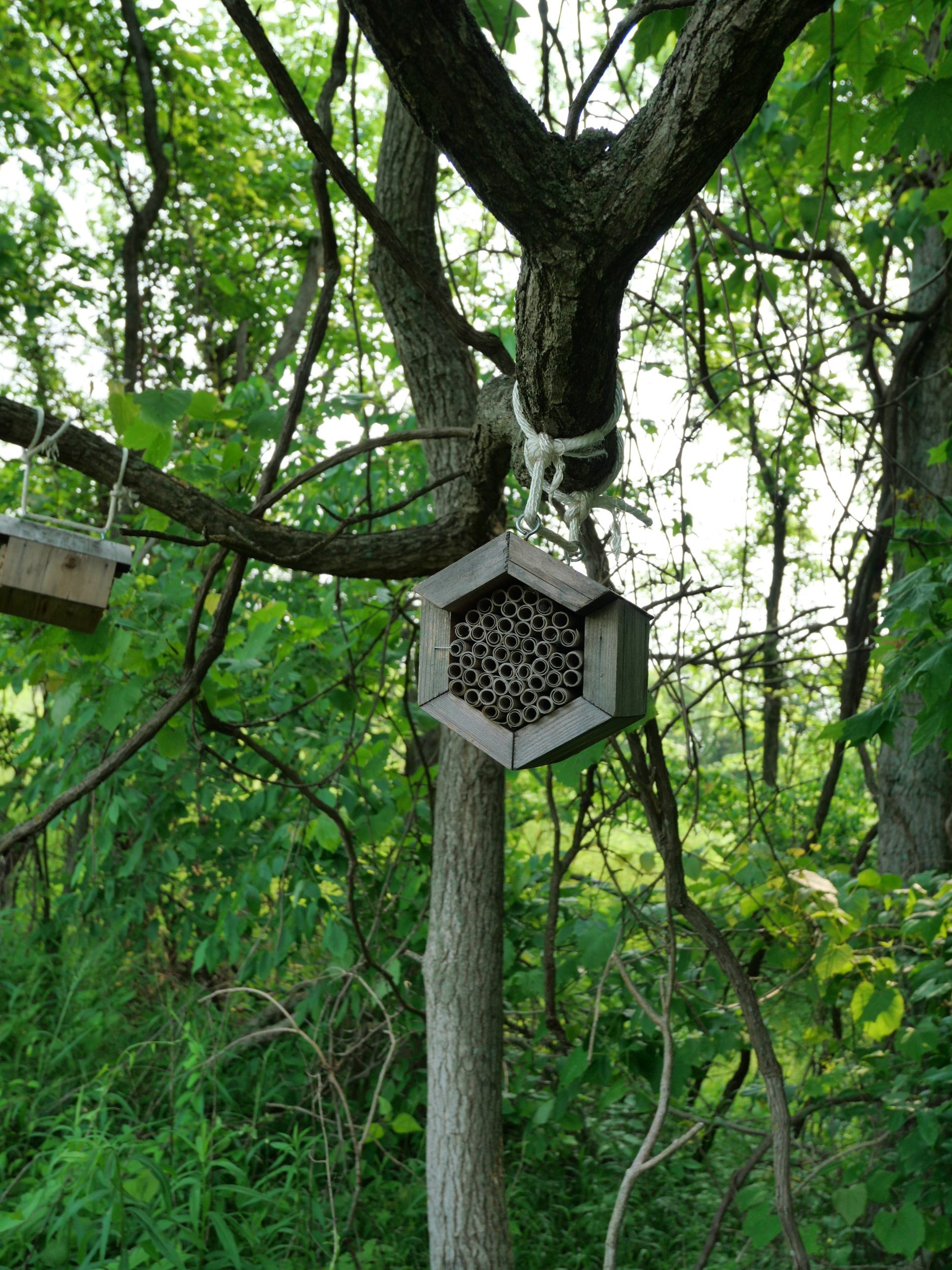
Bee trap
Betley Woods at Glacier's End bee trap
Bee Community Survey at Betley Woods
Written By: Max Gerke
Date Published: May 19, 2026
Max Gerke
I would venture to say that the first image conjured by this word is the very common, honey-producing lady: the European Honey Bee. That’s not exactly what we are talking about here, though. We are surveying for our native bees. These bees range in size from smaller than a grain of rice up to big, fuzzy bumblebees. It may surprise you to learn there are around 450 species in the state of Indiana alone! The hanging nest traps are one way that we are surveying this preserve to understand the native bees that call this place home.
“But don’t bees live in colonies?” you might ask. Some do, but ninety percent of our bees are solitary, meaning that a single female gathers pollen and provisions her own nest cell for her young (larvae). And not all bees prefer the same style of home. Believe it or not, most of our bees—around seventy percent—are ground-nesting. The other thirty percent nest above ground in plant stems or fallen logs…and some even build nests out of pebbles or material they mix themselves.
This is where the nest traps come into play. We have provided a place for those above-ground nesting bees to build in, so we can identify some of the species on the property.
“Ok, so you have traps for above-ground bees. Does that mean you have traps in the ground too?” I’m glad you asked, because we have a different way of looking for ground-nesting bees.
The main way we are surveying for the majority of our bees is with a hand net. Imagine a picturesque day in summer with the sun shining and dappled clouds in the sky. Flowers are blooming around you in yellow, white, purple, pink, and orange. To survey for bees, we walk by these flowers, doing what’s called a meander survey, and catch the bee visitors on each of them.
The surveys are timed to make them repeatable each year so the results can be compared evenly. We only catch bees from a single species of flower at a time as well, so we can include the ecological information with each specimen. Sometimes the flower can be important in determining what the bee species is.
A third way we are going to survey this year is with bowl traps. Bowl trapping is a passive method of surveying bees that allows us to catch those bees that are hard to get or are just too small for a hand net. It involves setting out condiment cups that are painted red, blue, white, and yellow to mimic flower colors. Each “bowl” is filled with a soapy solution to attract bees in. The Indiana Land Protection Alliance, in partnership with the Indiana Academy of Science and Indiana Native Plant Society, recently awarded our organization a bioinventory grant. The grant funds bowl trapping and specimen identification by a certified taxonomist.
“Well that’s cool. So why are you doing this?” Thanks, we think so too! One big reason why: Betley Woods at Glacier’s End resides in a very unique area within the state. The most recent glacial advancement stopped right on the property, mixing glaciated and unglaciated soils. This created the soil habitat for some 500 species of vascular plants to grow. That in turn creates habitat for a diverse array of wildlife—including bees. These bees forage from the flowers of the plants, use the stems for nesting, and even cut out pieces of leaf to line nest cells.
In other words: We expect a vast diversity of bees on the site. A bioblitz was performed in 2015, so we know a lot about the flora and fauna of the preserve. But bees were not surveyed. Also, the results of a bee one-day survey would be incomplete. That’s because different species of native bees emerge and forage at different times throughout the year as different flowers bloom through the seasons. Some only gather pollen from a single species of flower. That’s why we survey multiple times a year, making sure we can survey from different flowers as different bees are flying, so we can get a more complete picture of what the community of bees looks like.
We will continue to do this over the course of the next three to five years, and then compare the changes from year to year. We’ll see how the community of bees is changing and add any species we may have missed. Since the property is so diverse, we hope to collect threatened or endangered bee species too. Using all this information, we can add to the understanding of the distribution and presence of more imperiled species. All of which furthers conservation in the state.
Whenever and wherever you explore nature, the next time you are out I hope you’ll find some flowers and see who is gathering pollen. I bet you find a cute bee.

Mary Callaghan
Assistant Outreach Biologist, International Crane Foundation
Mary Callaghan is an Assistant Outreach Biologist for the International Crane Foundation. Her work aims to educate Indiana communities on Whooping and Sandhill cranes, their habitats, and how we can all work together to mitigate threats that these birds face. She is responsible for monitoring populations of these species on their wintering grounds across Indiana, most importantly tracking movements of the endangered Whooping Crane. Her Golden Hour presentation was one of our most popular events of 2026.

Ben Valentine
Guest Blogger
Ben Valentine is a founding member of the Friends of Marott Woods Nature Preserve and is active in several other conservation organizations. He leads a series of NUVO interviews with Indiana's environmental leaders, and he cherishes showing his son all the wonders of nature he grew up loving.

DJ Connors
Guest Blogger
DJ Connors, a Central Indiana native and late-to-life hunter, combines a lifelong appreciation for wildlife and the outdoors with a deep passion for exploring the natural beauty of the area he has called home for most of his life. As a husband and father of three, he is committed to ensuring his children have the same opportunities to connect with nature and appreciate the outdoors in their community. DJ’s unique journey into hunting emphasizes sustainability, responsible stewardship, and the importance of preserving these experiences for future generations.

Bridget Walls
Guest Blogger
Bridget is our first ever Communications and Outreach Intern. She is a graduate of Marian University, where she combined English, studio art, and environmental sciences in her degree studies. As treasurer for Just Earth, the university's environmental club, she helped plan events encouraging a responsible relationship between people, nature, and animals.

Jordan England
Guest Blogger
Jordan England is a lifelong Shelby County resident who graduated from Waldron Jr. Sr. High School (just a few miles from Meltzer Woods!). After earning her B.S. degree in Retail Management from Purdue University, she returned to Waldron to start a family with her husband, Brian. Together they have 3 young children and enjoy sharing with them their love of the community. Jordan is the Grants and Nonprofit Relations Director at Blue River Community Foundation, managing BRCF’s grant program, providing support to local nonprofits, and promoting catalytic philanthropy in Shelby County.

Cliff Chapman
President and CEO
As CILTI’s President and CEO, Cliff keeps CILTI’s focus on good science and stewardship. He’s mindful that the natural places you love took thousands of years to evolve and could be destroyed in a single day, and that knowledge drives his dedication to their protection.

Ryan Fuhrmann
Board Chair
Ryan C. Fuhrmann, CFA, is President and founder of Fuhrmann Capital LLC, an Indiana-based investment management firm focused on portfolio management. Ryan’s interest in land conservation centers around a desire to help preserve natural habitats for wildlife and the subsequent benefits it brings to people and the environment.

Joanna Nixon
Board Member
Joanna Nixon is the owner of Nixon Consulting, an Indianapolis-based strategy and project management firm focused on the nonprofit sector. She currently serves as the Philanthropic Advisor for the Efroymson Family Fund. Prior to opening her consulting practice in 2000, Joanna was vice-president for grantmaking at Central Indiana Community Foundation (CICF). Joanna has more than 25 years of experience in the nonprofit and arts and culture sector. She is passionate about the environment and loves bringing big ideas to life and creating high-quality arts and culture programs and experiences. Joanna enjoys outdoor adventures, including competing in fitness obstacle course races and hiking with her high energy Australian Cattle Dog, Jackson.

Karen Wade
Board Member
Before retiring, CILTI board member Karen Wade worked for Eli Lilly & Co. In retirement she volunteers for a number of organizations, including the Indiana Master Naturalist program, Johnson County Native Plant Partnership CISMA, Meadowstone Therapeutic Riding Center, and Leadership Johnson County.

David Barickman
Director of Advancement
Born and raised in Central Illinois, David spent many days as a child wandering around the river, forest and lakes there. Now he enjoys working with CILTI donors, helping them to protect nature through their giving. When not working, David loves to be outdoors hiking, fly fishing, kayaking or woodworking.

Jamison Hutchins
Stewardship Director
Jamison leads our stewardship team in caring for the land that is so important to you. He comes to our team after eight years as Bicycle and Pedestrian Coordinator for the city of Indianapolis, where his work had a positive impact from both health and environmental perspectives.
Robert McCrea
Land Protection Director
Robert grew up in Bloomington, IN, where he opted for exploring the hills of southern Indiana rather than the expected high school extracurricular pursuits. This formative time set the tone for his career in conservation. Most recently, Robert was an attorney at Conservation Law Center and provided counsel to land trusts and conservation partnerships throughout Indiana. As CILTI's Land Protection Director, he works to protect Central Indiana’s remaining natural areas.

Jen Schmits Thomas
Media Relations
An award-winning communicator and recognized leader in Central Indiana’s public relations community, Jen helps us tell our story in the media. She is the founder of JTPR, which she and her husband John Thomas own together. She is accredited in public relations (APR) from the Public Relations Society of America, and loves to camp and hike in perfect weather conditions.

Shawndra Miller
Communications Director
Shawndra’s earliest writing projects centered around the natural world, starting when a bird inspired her to write her first “book” in elementary school. Now she is in charge of sharing our story and connecting you to our work. Through our print and online materials, she hopes to inspire your participation in protecting special places for future generations.

Phillip Weldy
Stewardship Manager
Phillip enjoys nature’s wonders from an up-close-and-personal perspective as he works to restore the natural places you love. As an AmeriCorps member in Asheville, NC, he had his first full immersion in relatively undisturbed land while reconstructing wilderness trails in National Parks and National Forests.









September 15, 2026
A great thought partner. A trusted colleague. A joyful spirit. These are some of the ways people describe Stacy Cachules, former COO of Central Indiana Land Trust. This spring, Stacy left our team after 15 years to assume leadership of the River Network, a national nonprofit.
Bonus Content,Newsroom

September 14, 2026
FOR IMMEDIATE RELEASE $450,000 gift expands “part of the Mount Rushmore of Indiana”
Newsroom,Press Releases,Properties

August 26, 2026
FOR IMMEDIATE RELEASE Thousands of trees planted slowed water’s flow along the river during flooding The Central Indiana Land Trust, Inc. (CILTI) has spent two decades saving forested wetlands and planting thousands of trees in three areas along the White River in Hamilton County that aid in slowing down [...]
Conservation Easements,Newsroom,Nonie Krauss Nature Preserve,Olivers Woods,Properties,Stewardship
