
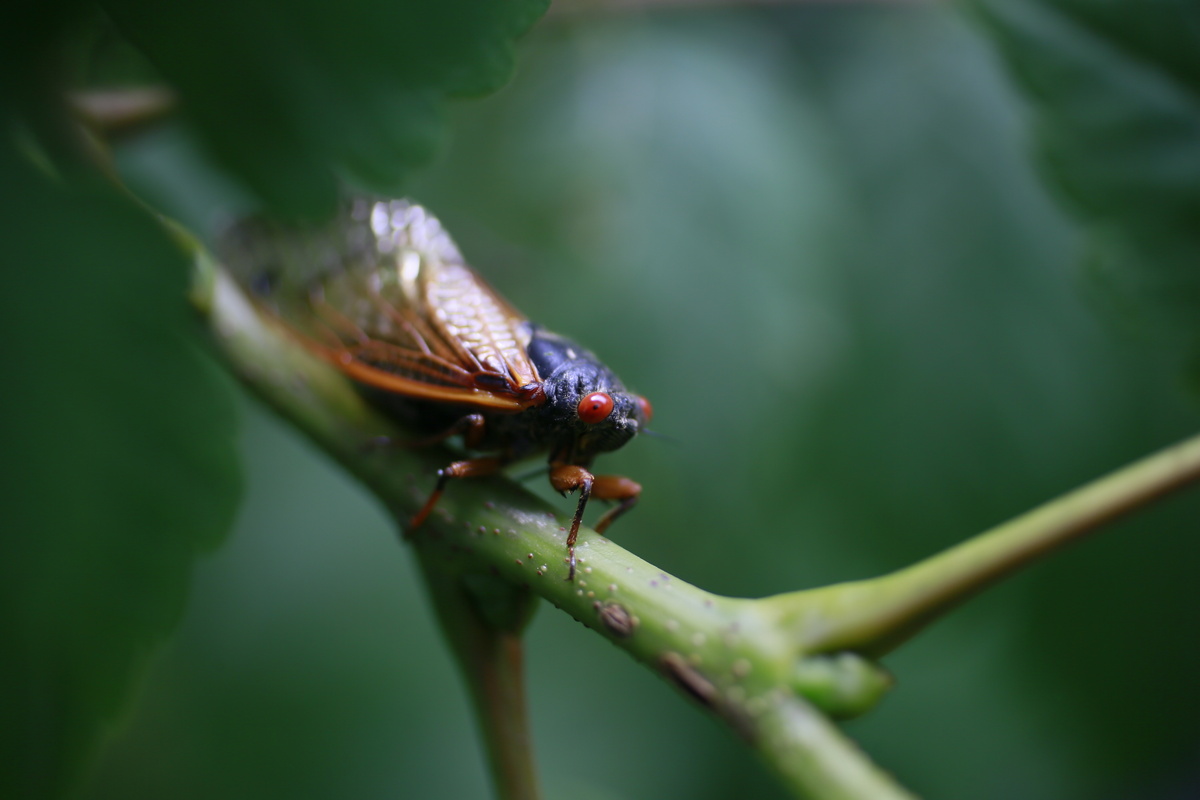
Early Brood X Cicada
Early Brood X Cicada
Brood X is coming (but please don’t believe it’s an “invasion”).
Written By: Traci Willis
Date Published: May 13, 2021
Traci Willis
by Traci Willis, Outreach Specialist
Many headlines have begun to default to negative metaphors such as “invasion” or “infestation” when reporting about the upcoming periodical cicada emergence called Brood X. It’s true that at their highest concentration, there may be 1.5 million cicadas per acre in some areas. While that can feel overwhelming, cicadas aren’t harmful to people or pets, and they don’t bite or sting. In reality, they’re nearly defenseless!
What they will do is provide many benefits to the ecosystems where they emerge. They will prune weak tree branches, aerate and fertilize the soil, and provide increased food resources (both underground during the year leading up to hatching and especially the year they emerge above ground). This abundance will be relished by fish, turkeys, squirrels, voles, birds, amphibians, insects and spiders.
Raptors and larger mammals will also benefit from this bounty, because their prey will be well-fed. Even humans with an adventurous appetite can eat them as a good source of protein.
Despite often being lumped in with locusts, cicadas are not at all related to the grasshoppers that are capable of destroying fields of food crops. And Brood X cicadas aren’t the same insects as the annual “dog days” cicadas that emerge annually near the end of summer. The periodical cicadas of Brood X are smaller than their annual cousins at just 1.5 inches. They’re also black with red eyes, while annual cicadas are green.
Cicadas are best known for the songs sung by the male cicadas. Males sing by flexing their tymbals, which are drum-like organs found in their abdomens. Small muscles rapidly pull the tymbals in and out of shape. Their songs are heard from early morning into late evening if there are adults present.
Brood X cicadas begin life as a rice-shaped egg, which the female deposits in a groove she makes in the twig-sized branches of a tree limb. The groove provides shelter and exposes the tree fluids, which the young cicadas drink.
These grooves can kill small branches. When the branches die and the leaves turn brown, it is called flagging. If damage to a newly planted seedling occurs, it will likely sprout again from the root collar.
The eggs stay in the branch for six weeks, after which the nymphs emerge to drop to the earth. They will burrow down to the tree roots, where they will drink for the next 17 years without causing damage to the host tree.
This spring, in their 17th year, they will re-emerge as adults once the soil temperature reaches 64 degrees, after a warm rain.
On properties with no trees older than 17, there may not be very many cicadas present. Here’s why: The cicada nymphs need to feed constantly while underground and they can’t travel any great distance in the soil. They have spent the last 17 years drinking from the tree’s roots. If the tree wasn’t an established tree 17 years ago or it has been removed, there won’t be any cicada adults to return to the surface this year.
 A final reminder: These periodical cicadas are native to our ecosystem. The trees in our forests and yards have survived many generations with the periodical cicadas. Healthy, established trees can withstand any damage by egg-laying cicadas. We only have about six weeks to enjoy this extraordinary phenomenon, so let’s sit back and marvel at this amazing show.
Interested in sharing a cicada experience with other nature-lovers? We are planning a cicada talk on Friday, June 18 at 4pm at Oliver’s Woods. Bug Expert Dr. Elizabeth Barnes from Purdue University will be joining us for the talk. Find more upcoming events on our calendar.

Ben Valentine
Guest Blogger
Ben Valentine is a founding member of the Friends of Marott Woods Nature Preserve and is active in several other conservation organizations. He leads a series of NUVO interviews with Indiana's environmental leaders, and he cherishes showing his son all the wonders of nature he grew up loving.

DJ Connors
Guest Blogger
DJ Connors, a Central Indiana native and late-to-life hunter, combines a lifelong appreciation for wildlife and the outdoors with a deep passion for exploring the natural beauty of the area he has called home for most of his life. As a husband and father of three, he is committed to ensuring his children have the same opportunities to connect with nature and appreciate the outdoors in their community. DJ’s unique journey into hunting emphasizes sustainability, responsible stewardship, and the importance of preserving these experiences for future generations.

Bridget Walls
Guest Blogger
Bridget is our first ever Communications and Outreach Intern. She is a graduate of Marian University, where she combined English, studio art, and environmental sciences in her degree studies. As treasurer for Just Earth, the university's environmental club, she helped plan events encouraging a responsible relationship between people, nature, and animals.

Jordan England
Guest Blogger
Jordan England is a lifelong Shelby County resident who graduated from Waldron Jr. Sr. High School (just a few miles from Meltzer Woods!). After earning her B.S. degree in Retail Management from Purdue University, she returned to Waldron to start a family with her husband, Brian. Together they have 3 young children and enjoy sharing with them their love of the community. Jordan is the Grants and Nonprofit Relations Director at Blue River Community Foundation, managing BRCF’s grant program, providing support to local nonprofits, and promoting catalytic philanthropy in Shelby County.

Cliff Chapman
President and CEO
As CILTI’s President and CEO, Cliff keeps CILTI’s focus on good science and stewardship. He’s mindful that the natural places you love took thousands of years to evolve and could be destroyed in a single day, and that knowledge drives his dedication to their protection.
Stacy Cachules
Chief Operating Officer
Among her many key duties as Assistant Director, Stacy has the critical task of tracking our budget, making sure we channel donations for maximum efficiency. When her workday’s done, Stacy loves to spend time with her two young boys—and when not traveling, she’s likely planning the next travel adventure.

Ryan Fuhrmann
Board Chair
Ryan C. Fuhrmann, CFA, is President and founder of Fuhrmann Capital LLC, an Indiana-based investment management firm focused on portfolio management. Ryan’s interest in land conservation centers around a desire to help preserve natural habitats for wildlife and the subsequent benefits it brings to people and the environment.

Joanna Nixon
Board Member
Joanna Nixon is the owner of Nixon Consulting, an Indianapolis-based strategy and project management firm focused on the nonprofit sector. She currently serves as the Philanthropic Advisor for the Efroymson Family Fund. Prior to opening her consulting practice in 2000, Joanna was vice-president for grantmaking at Central Indiana Community Foundation (CICF). Joanna has more than 25 years of experience in the nonprofit and arts and culture sector. She is passionate about the environment and loves bringing big ideas to life and creating high-quality arts and culture programs and experiences. Joanna enjoys outdoor adventures, including competing in fitness obstacle course races and hiking with her high energy Australian Cattle Dog, Jackson.

Karen Wade
Board Member
Before retiring, CILTI board member Karen Wade worked for Eli Lilly & Co. In retirement she volunteers for a number of organizations, including the Indiana Master Naturalist program, Johnson County Native Plant Partnership CISMA, Meadowstone Therapeutic Riding Center, and Leadership Johnson County.

David Barickman
Development Director
Born and raised in Central Illinois, David spent many days as a child wandering around the river, forest and lakes there. He works behind the scenes as a key member of our fundraising team. When not working, David loves to be outdoors hiking, fly fishing, kayaking or woodworking.

Jamison Hutchins
Stewardship Director
Jamison leads our stewardship team in caring for the land that is so important to you. He comes to our team after eight years as Bicycle and Pedestrian Coordinator for the city of Indianapolis, where his work had a positive impact from both health and environmental perspectives.

Jen Schmits Thomas
Media Relations
An award-winning communicator and recognized leader in Central Indiana’s public relations community, Jen helps us tell our story in the media. She is the founder of JTPR, which she and her husband John Thomas own together. She is accredited in public relations (APR) from the Public Relations Society of America, and loves to camp and hike in perfect weather conditions.

Shawndra Miller
Communications Director
Shawndra’s earliest writing projects centered around the natural world, starting when a bird inspired her to write her first “book” in elementary school. Now she is in charge of sharing our story and connecting you to our work. Through our print and online materials, she hopes to inspire your participation in protecting special places for future generations.

Phillip Weldy
Stewardship Manager
Phillip enjoys nature’s wonders from an up-close-and-personal perspective as he works to restore the natural places you love. As an AmeriCorps member in Asheville, NC, he had his first full immersion in relatively undisturbed land while reconstructing wilderness trails in National Parks and National Forests.










March 22, 2026
When you’re walking in the woods in the spring, it’s clear that life is all around you. Giant trees tower above you. The birds sing with their melodious voices. At your feet, ephemeral flowers bloom in radiant hues of color. Surrounded by beauty, it’s easy to be captivated by [...]
Newsroom,Properties,Stewardship
February 2, 2026
Kidneys of the planet. Biodiversity hotspots. Sponges. These are just some of the ways wetlands can be described, according to Gary Lamberti, Nieuwland Professor of Aquatic Science at the University of Notre Dame.
Browning Marsh,Meltzer Woods,Newsroom,Properties
January 21, 2026
Dick Miller (second from left, above) is a longtime land trust member with a history of rolling up his sleeves. He started off by bringing his Butler students to volunteer events in the late 2000s. After retirement, he volunteered weekly and later joined the board of directors. His beautiful [...]
Legacy,Newsroom
