
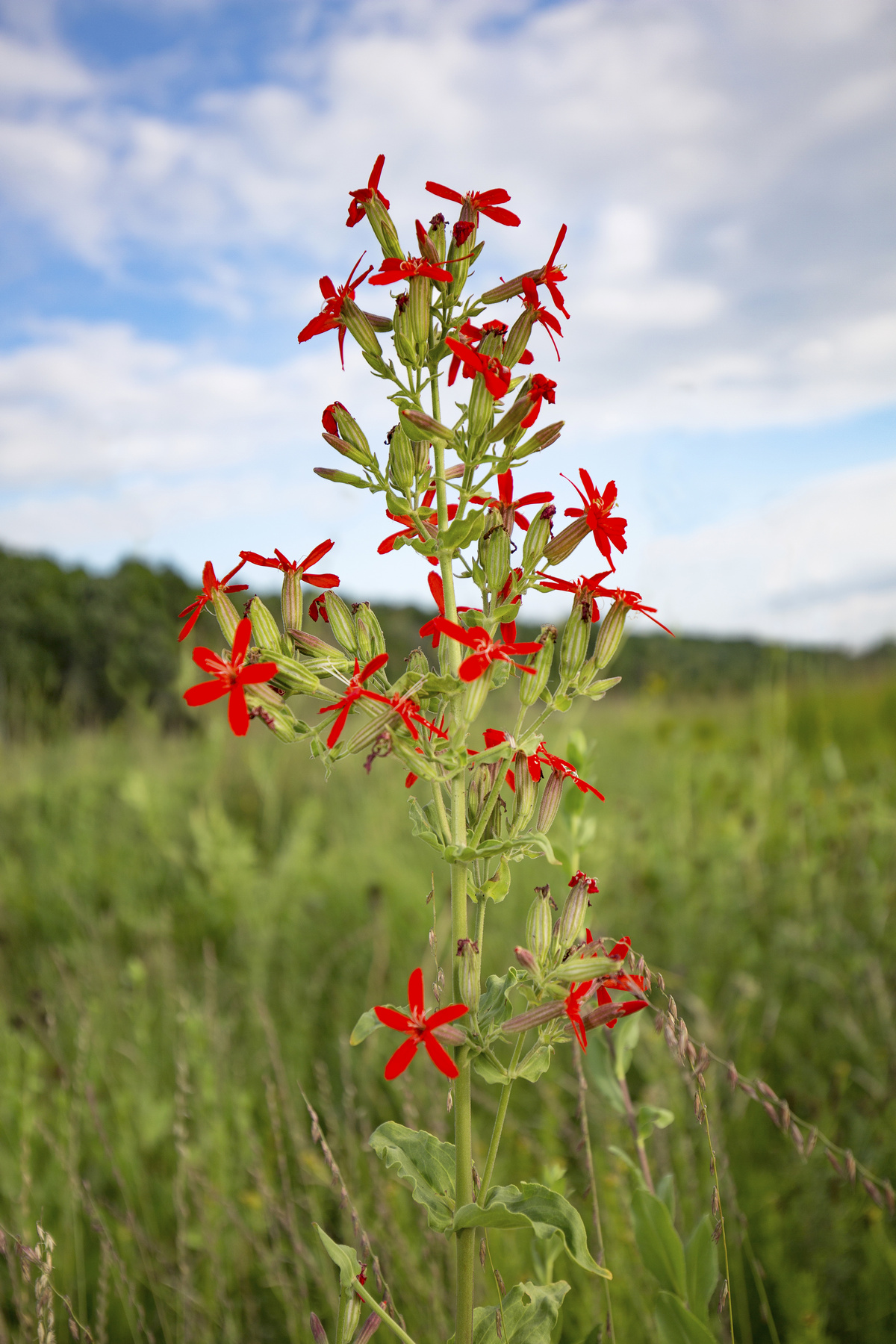
Royal Catchfly
Royal Catchfly (Silene regia)
Smith Cemetery Nature Preserve: A Prairie Remnant
Written By: John Bacone
Date Published: April 29, 2025
John Bacone
Our board secretary, John Bacone, was director of the DNR Division of Nature Preserves for 40 years. He offers this historical view of one of Indiana’s last remaining prairie remnants.
In presettlement times, much of northwest and west-central Indiana was covered by prairie vegetation. The vast prairie was soon converted to agricultural fields. The only remaining prairie can be found in some railroad rights-of-way and occasionally in old pioneer cemeteries that were set aside prior to the agricultural conversion. Dr. Robert Betz, a professor at Northeastern Illinois University, had spent years looking for cemetery prairies, both in Illinois and northwest Indiana, and he provided the Indiana Division of Nature Preserves (DNP) with his findings.
In the late 1970s, DNP ecologists conducted a systematic inventory in 25 counties to see if we could locate additional cemetery prairies. Dr. Betz had taught us to search for prairie plants in the fencerows surrounding the cemeteries, and close to the tombstones, where the mowers might not have trimmed meticulously. If we found a few prairie grasses or forbs there, then we would look carefully in the mowed portions of the cemetery, where “bonsai” prairie plants might be lurking. If the cemetery caretakers had applied broad-leaved herbicides, we would be out of luck.
We believed we had found a pioneer prairie cemetery on August 2, 1979, when we visited the Smith Cemetery, located on SR 63 in Vermillion County. We spotted the rare Royal Catchfly, Silene regia, and several other prairie plants in the north fencerow. This plant is state-endangered and extremely rare in Indiana, and we were ecstatic.
In 1980, during a subsequent field visit, 18 prairie species were located in the north and west fencerows. We nominated Smith Cemetery to the Indiana Natural Areas Registry, and Registry Director Paul Carmony contacted the Highland Township Trustee Delores Hicks, who was in charge of taking care of Smith Cemetery. Her husband Carl, and his father before him had been the Township Trustee in the past.
Paul met with them and explained about the remnant prairie and how rare it was. Paul asked them if they would consider “letting it go,” ceasing mowing. They agreed and were excited about the idea of restoring a prairie remnant. They requested we erect a sign of explanation, and asked that we give the prairie cemetery some publicity by writing an article about it for the local newspaper, and giving a talk about it to the Lion’s Club. We agreed.
The sign we erected stated: “This cemetery prairie is being preserved and managed as a living memorial to the settlers who are buried here. This prairie is one of the last remnants of the vast prairies that once covered this county.” The Hicks agreed to stop cutting and mowing, and to let us burn the prairie to see if that would help the prairie recover. The first prescribed burn took place March 28, 1982.
After the mowing stopped, other prairie flowers popped up and bloomed. We saw lots of purple prairie coneflower, royal catchfly, bergamot, lead plant, and Culver’s root, among others. By 1982, after the burn, 35 prairie species had reasserted themselves. Dolores and Carl Hicks were pleased that the restoration was accepted by their constituents in the township. There was some TV coverage, and Lee Casebere wrote some excellent articles about the prairie in local newspapers.
Our modern culture has conditioned us to expect closely mowed cemeteries. We soon learned that some folks didn’t like the unmowed cemetery. We also learned that some folks who were coming to the cemetery to visit their loved ones were uncomfortable wading through the vegetation. To assist those who had an interest in visiting, we contracted with Lois Mittino Gray, a former state park naturalist, and she took on the task of documenting all of the stones in the cemetery.
After making rubbings of all the stones, and conducting research at the local libraries, she put together a very thorough report, called “Inventory Listing of Stones for Smith Cemetery, Vermilion County Indiana, 1984 and 1986.” Copies were given to the Highland Township Office, the Vermillion County Historical Society, the Indiana Historical Society, the Indiana State Library, and the libraries in Perrysville, Cayuga, and Clinton County.
Reading the report is like being taken back in time. It reminds one of Edgar Lee Masters’ Spoon River Anthology, but without the gossip. There are 149 people buried in Smith Cemetery, including 25 children under one year of age. There are 26 children between ages one and 15 years. The oldest burial is Sarah Gonger, September 26, 1823.
Ms. Gray documents the shape of the headstones, their composition (sandstone, limestone, granite, and “unknown sparkly white.”) Twenty-three stones had carved symbols: broken candle, weeping willow, finger pointing towards heaven, lamb at rest, dove, anchor, open bible, and hands clasped in friendship. Sixteen stones had an epitaph. And there is a map, so visitors can locate the grave they are seeking.
Included in the report are selected biographies of noted people and families buried in Smith Cemetery. For instance, Jacob Rudy, a shoemaker and wealthy landowner. One can learn where he emigrated from (Switzerland); how much he paid in taxes ($448 in 1887); how many wives he had (2); how many children (4); and so on.
This report was well received, and helped the Hicks defend their decision to let the cemetery revert to prairie. Periodically, they receive complaints about the cemetery being unkempt, but overall, it has been well received. Smith Cemetery was dedicated as a state nature preserve on September 3, 1997, with the documents being signed by Dolores Hicks, Township Trustee, and her three Advisory Board members.
The Division of Nature Preserves has tried to permanently protect several other prairie cemeteries around the state. For years, cemetery trustees allowed us to manage them in Fountain, Clinton, Harrison, and a few other counties. Unfortunately, public complaints led the Trustees to resume mowing. But to some, who view these cemetery prairies and revel in thinking about what once had been, they are an inspiration.
In 1990, Bloomington resident Pam Hazer was inspired after reading Lee Casebere’s 1990 article in Outdoor Indiana, titled “Of Pioneers and Prairies.” She wrote this poem in appreciation:
Now here’s a poem for all you pioneers,
a hundred and fifty years gone
From the Indiana soil….
And a tribute even love can’t give.
The wild and native prairie flowers live
Around your graves’ old stones…
And wind their stems among the prairie grass,
Around your stone-marked tombs.
Here there is no room for death—
The flowers live…
And, breath for breath,
Exchange the elements from old bone.
All the minerals combined, new-blessed—
You who plowed her are the prairie’s own.
—Pamela Hazer

Ben Valentine
Guest Blogger
Ben Valentine is a founding member of the Friends of Marott Woods Nature Preserve and is active in several other conservation organizations. He leads a series of NUVO interviews with Indiana's environmental leaders, and he cherishes showing his son all the wonders of nature he grew up loving.

DJ Connors
Guest Blogger
DJ Connors, a Central Indiana native and late-to-life hunter, combines a lifelong appreciation for wildlife and the outdoors with a deep passion for exploring the natural beauty of the area he has called home for most of his life. As a husband and father of three, he is committed to ensuring his children have the same opportunities to connect with nature and appreciate the outdoors in their community. DJ’s unique journey into hunting emphasizes sustainability, responsible stewardship, and the importance of preserving these experiences for future generations.

Bridget Walls
Guest Blogger
Bridget is our first ever Communications and Outreach Intern. She is a graduate of Marian University, where she combined English, studio art, and environmental sciences in her degree studies. As treasurer for Just Earth, the university's environmental club, she helped plan events encouraging a responsible relationship between people, nature, and animals.

Jordan England
Guest Blogger
Jordan England is a lifelong Shelby County resident who graduated from Waldron Jr. Sr. High School (just a few miles from Meltzer Woods!). After earning her B.S. degree in Retail Management from Purdue University, she returned to Waldron to start a family with her husband, Brian. Together they have 3 young children and enjoy sharing with them their love of the community. Jordan is the Grants and Nonprofit Relations Director at Blue River Community Foundation, managing BRCF’s grant program, providing support to local nonprofits, and promoting catalytic philanthropy in Shelby County.

Cliff Chapman
President and CEO
As CILTI’s President and CEO, Cliff keeps CILTI’s focus on good science and stewardship. He’s mindful that the natural places you love took thousands of years to evolve and could be destroyed in a single day, and that knowledge drives his dedication to their protection.
Stacy Cachules
Chief Operating Officer
Among her many key duties as Assistant Director, Stacy has the critical task of tracking our budget, making sure we channel donations for maximum efficiency. When her workday’s done, Stacy loves to spend time with her two young boys—and when not traveling, she’s likely planning the next travel adventure.

Ryan Fuhrmann
Board Chair
Ryan C. Fuhrmann, CFA, is President and founder of Fuhrmann Capital LLC, an Indiana-based investment management firm focused on portfolio management. Ryan’s interest in land conservation centers around a desire to help preserve natural habitats for wildlife and the subsequent benefits it brings to people and the environment.

Joanna Nixon
Board Member
Joanna Nixon is the owner of Nixon Consulting, an Indianapolis-based strategy and project management firm focused on the nonprofit sector. She currently serves as the Philanthropic Advisor for the Efroymson Family Fund. Prior to opening her consulting practice in 2000, Joanna was vice-president for grantmaking at Central Indiana Community Foundation (CICF). Joanna has more than 25 years of experience in the nonprofit and arts and culture sector. She is passionate about the environment and loves bringing big ideas to life and creating high-quality arts and culture programs and experiences. Joanna enjoys outdoor adventures, including competing in fitness obstacle course races and hiking with her high energy Australian Cattle Dog, Jackson.

Karen Wade
Board Member
Before retiring, CILTI board member Karen Wade worked for Eli Lilly & Co. In retirement she volunteers for a number of organizations, including the Indiana Master Naturalist program, Johnson County Native Plant Partnership CISMA, Meadowstone Therapeutic Riding Center, and Leadership Johnson County.

David Barickman
Development Director
Born and raised in Central Illinois, David spent many days as a child wandering around the river, forest and lakes there. He works behind the scenes as a key member of our fundraising team. When not working, David loves to be outdoors hiking, fly fishing, kayaking or woodworking.

Jamison Hutchins
Stewardship Director
Jamison leads our stewardship team in caring for the land that is so important to you. He comes to our team after eight years as Bicycle and Pedestrian Coordinator for the city of Indianapolis, where his work had a positive impact from both health and environmental perspectives.

Jen Schmits Thomas
Media Relations
An award-winning communicator and recognized leader in Central Indiana’s public relations community, Jen helps us tell our story in the media. She is the founder of JTPR, which she and her husband John Thomas own together. She is accredited in public relations (APR) from the Public Relations Society of America, and loves to camp and hike in perfect weather conditions.

Shawndra Miller
Communications Director
Shawndra’s earliest writing projects centered around the natural world, starting when a bird inspired her to write her first “book” in elementary school. Now she is in charge of sharing our story and connecting you to our work. Through our print and online materials, she hopes to inspire your participation in protecting special places for future generations.

Phillip Weldy
Stewardship Manager
Phillip enjoys nature’s wonders from an up-close-and-personal perspective as he works to restore the natural places you love. As an AmeriCorps member in Asheville, NC, he had his first full immersion in relatively undisturbed land while reconstructing wilderness trails in National Parks and National Forests.









February 5, 2025
“Should I get rid of it?” “What’s the best way to eradicate it?” “What should I put there instead?” Our stewardship team gets a lot of great questions about invasive species!
Meltzer Woods,Newsroom,Olivers Woods,Properties,Stewardship

January 30, 2025
Part 4 of our “Staff Picks” series for National Book Blitz Month I was solving a jigsaw puzzle the other day—one with the Chicago skyline where the entire top was a bright blue sky. There was one piece of that sky that was eluding me. Annoying! But after a [...]
Newsroom

January 23, 2025
Part 3 of our “Staff Picks” series for National Book Blitz Month Monarch and Milkweed, by Helen Frost and Leonid Gore Helen Frost’s Monarch and Milkweed is a captivating book that explores the extraordinary connection between monarch butterflies and the milkweed plant. Frost’s lyrical prose pairs perfectly with Leonid [...]
Newsroom
